Our Work
Neighbourhood Health

Neighbourhood Health

Logo shape full circle
Logo shape piece odd circle

Neighbourhood health is a national change in the way healthcare services are delivered.

It’s designed to deliver more care in community settings and use shared data so that health services are coordinated and easier to navigate.

Healthcare staff from primary care settings like GP surgeries and pharmacies will work more closely with social care, mental health teams, community practitioners and VCSE organisations, like charities and community groups. They will all come together to work in a ‘Neighbourhood’ area in Neighbourhood Multidisciplinary Teams (MDTs).

For Wakefield these Neighbourhood areas are:
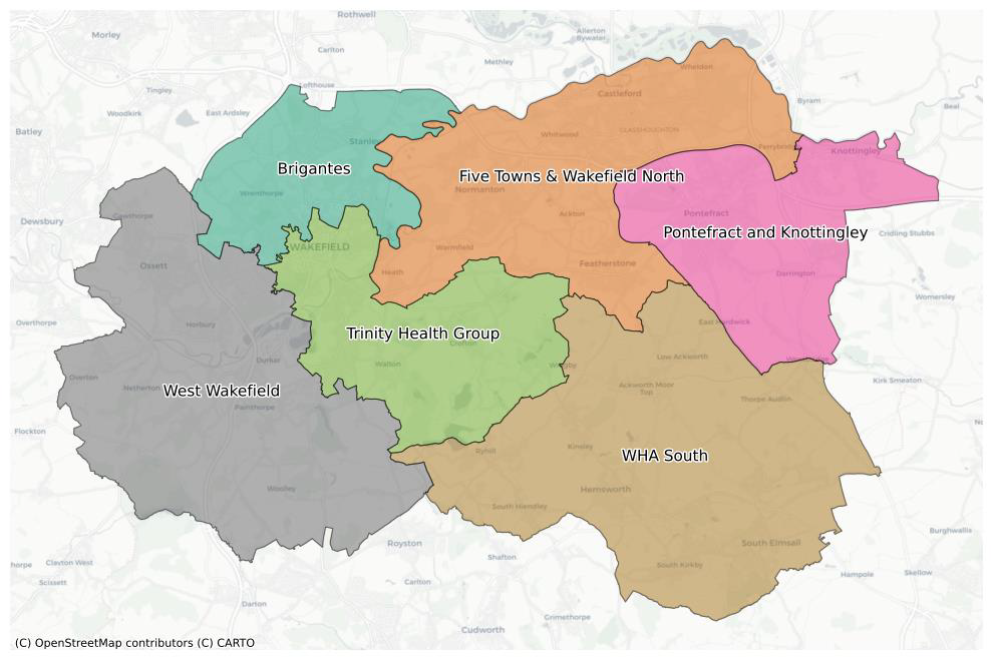
  • Brigantes – Wrenthorpe, Outwood, Stanley, and parts of Altofts
  • West Wakefield – Ossett, Horbury, Netherton, West Bretton and Woolley
  • Trinity Health Group – Wakefield Centre, Crigglestone, Sandal, Crofton and Walton
  • Five Towns and Wakefield North – Castleford, Airedale and Ferrybridge
  • Pontefract and Knottingley – Pontefract, Knottingley, Darrington and East Hardwick
  • Wakefield South – Havercroft and Ryhill, Hemsworth, South Elmsall, South Kirby, Badsworth, Ackworth and Upton

Integrated neighbourhood health is built on three big "shifts" set out in the NHS 10 Year Plan:

  • From Hospital to Community: Bringing more care into people’s homes so they can stay independent.
  • From Treatment to Prevention: Finding health problems early before they become emergencies.
  • From Analogue to Digital: Using better technology to make sure staff have the right information at the right time.

National guidance published in March 2026 sets out a clear framework for this work.

What does this mean for Wakefield?

In Wakefield, we aren’t starting from scratch. Neighbourhood health builds on the "Connecting Care" approach, which already brings teams together.

In 2025-2026, it will be used with a specific group of patients who have Dementia, Chronic Pulmonary Disease (a serious lung condition) or are on End of Life care. This group of 14,591 people (about 3.7% of our population) was selected as these patients regularly have more hospitalisations, deterioration in health and have the most opportunity for us to improve how care is delivered.

The plan is that this approach will grow to support more patients each year, until this new multi-professional way of working is embedded and a new normal.

To make this work, the system is focusing on six key areas. Here is what they mean:

  • Population Health Management: Using joined-up data to identify people who are at risk of becoming unwell. It’s like an early-warning system to identify who needs extra help before a crisis happens.
  • Modern General Practice: This makes it easier to contact GP surgeries, whether that’s by phone, online, or in person. It’s about getting people to the right professional (like a pharmacist or a nurse) as quickly as possible.
  • Standardising Community Health Services: In the past, health services were often "split up" into different silos. If you had a physical illness (like a lung condition) and a mental health struggle (like anxiety or depression), you might have had to see two different teams who didn't always talk to each other. Standardising Community Health Services is about changing that by creating a "core offer" of high-quality care that is the same for everyone, no matter where they live in Wakefield.
  • Neighbourhood Multidisciplinary Teams: This is the heart of the plan. Bringing together doctors, nurses, social workers, and local VCSE organisations into "Neighbourhood Teams." They meet to talk about a person’s care and make sure everyone is working toward the same goal.
  • Integrated Intermediate Care: Where someone has been in hospital, the priority is to get them back to their own bed. With short-term rehab and support in the patient’s own home.
  • Urgent Neighbourhood services Help at Home: Where someone has a sudden health dip, "Virtual Wards" or quick-response teams can treat them at home with hospital-grade care, so they don't have to go to A&E.

Organisation

Framework Tier

Phone Number

Email Address

No items found.

Open Access Youth Provision (3 Rounds) - £720,000

Read more

Building Healthy and Sustainable Communities - £150,000

Read more

Increasing Cervical Screening Uptake Grant - £40,000

Read more

Group-Based Family Wellbeing Programmes - £20,000

Read more

Community Grants for Climate Activity - £233,312

Read more

Adult Social Care Grant - £80,000

Read more

Prosper and Nova Core Grants - £230,000

Read more

Community Mental Health Provision Fund - £69,500

Read more

Me and Menopause - £3,188 per organisation

Read more

West Yorkshire Core20PLUS5 Community Connectors: Supporting Pregnant Asylum Seekers & Refugees - £58,500

Read more

Thinking Differently Development Fund - £225,000

Read more

Future Selph Wakefield (16-25 Mental Health Project) - £774,798

Read more

Connecting Communities (Hospital Discharge Model) - £500,000

Read more

1

2

3

4

5

6

How do I apply?

1

2

3

4

5

6

Rebecca Dunford
Social Prescribing Services Manager
Shannon Simpson
Service Coordinator
Caroline Sylvester
Service Coordinator
Dawn Gzella
Service Coordinator
Gemma Naylor
Social Prescribing Advisor
Fareeda Mir
Social Prescribing Advisor
Dave Harrison
Social Prescribing Advisor
Gemma Newman
Social Prescribing Advisor
Helen Hackney
Social Prescribing Advisor
Adele Spaven
Social Prescribing Advisor
Justyna Banks
Social Prescribing Link Worker – Pontefract & Knottingley
Jazz Johal
Senior Social Prescribing Link Worker - West Wakefield PCN
Sharon Kennedy
Social Prescribing Link Worker - Wakefield Health Alliance South
Paul Boyd
Self Management Service Administrator
Alina Moisejeva
Service Support Officer
Cindy Stratford
Senior Social Prescribing Advisor
Megan Aspinall
Project Support Officer
Curtis Hollinsworth
Social Prescribing Advisor
Joanna Joy-Jones
Social Prescribing Advisor
Jack Gregson
Social Prescribing Link Worker
Liz Robinson
Social Prescribing Link Worker
Katty Keyhani from Alzheimer’s Society
The Health and Wellbeing Board
Sharlene Featherstone from Second Chance Headway
The Health and Care Partnership
Amaina Elzoubir from One Ummah Community
Health Inequalities Steering Group
Ross Grant from Wakefield & District Society for Deaf People
The People’s Panel
Stephanie Gillis from The Prince of Wales Hospice
The Transformation and Delivery Collaborative
Nikiesha Bragger from Turning Lives Around
Housing Health and Social Care Partnership
Stephen Halstead from Yorkshire Cancer Community
Wakefield and North Kirklees Cancer Locality Network System Group
Chris Bingham from Pontefract Reads
Wakefield Local Area SEND & AP Strategic Partnership Board
Anna Blight from Pontefract Reads
The Early Years Strategic Partnership Board
Steven Busfield from Empath Action
The Children and Young People’s Partnership and Early Help Board
Marie Rafferty from Compass Wakefield
Teenage Pregnancy Strategy Group
Paula Appleton from Evergreen Active
CYP Nutrition and Healthy Weight Steering Group
Laura McNally from Kidz Aware
Young Carers Strategy Group
Madeleine France from Blossom Training & Development
The Safer Together Partnership
Dick Davies from Wakefield District City of Sanctuary
Wakefield Multi-Agency Asylum Meeting
Duncan Smith from Trinity Church
Wakefield Carers Strategy Implementation Group
Jane Walton from Yorkshire Mentoring CIC
The Employment and Skills Strategy Group
James Heaton-Jennings from Camphill Wakefield
Wakefield Learning Disability & Autism Board
Daniel Atkinson from Reflections Yorkshire CIC
Combatting Drugs Partnership Board

Who is involved

The new Neighbourhood way of working will include a variety of professionals who will work together recognising each other’s disciplinary skills and roles: GPs, Community Nurses, Social Prescribers, Physiotherapists, Occupational Therapists, Social Workers, Paid Carers, Hospice clinicians, Live Well Wakefield, Dementia support, Carer’s support, pulmonary and respiratory care teams.

The role of the VCSE sector

Local charities, community groups, and faith organisations are all "system partners" in the neighbourhood health model. This means there is a place for Voluntary, Community and Social Enterprise (VCSE) organisations to use their knowledge to co-design services and integrate their work within the system.

As a VCSE organisation, you might see the impact of neighbourhood health in:

  • Funding: Neighbourhood health will influence strategic commissioning principles that shape the contract and grant opportunities for local VCSE organisations.
  • Signposting: Referral pathways to services may change and people may need help from VCSE organisations to navigate new systems.
  • Data: Partners will use shared information and insights, including data from the VCSE sector. Work is underway on a platform to enable this and we will provide updates.
  • Local services: Community health hubs are planned to open across the country in the long term, with a goal to have 250 nationally by 2035.

Nova is a charity that supports VCSE organisations working in Wakefield District to thrive. We are involved in discussions about what Neighbourhood Health will look like and how VCSE organisations are involved.

We have also received funding to make sure resident voices are meaningfully embedded in emerging work on Neighbourhood Health. As part of this, we have developed a project for Healthwatch Wakefield to work with Community Anchors and other key local VCSE organisations to provide information on Neighbourhood Health for communities and gather resident’s thoughts. This is happening between June and August 2026. Please contact our team if your organisation would like to get involved in this project: info@nova-wd.org.uk
What work is happening now?

A session was held on 24 February to share information about the concept of Neighbourhood Health with VCSE organisations and update on progress so far. This is envisioned as one of a series of events targeted at these groups and we will share dates once they are organised here.

Public, patient and community sessions are planned for June, July and August 2026 in each Neighbourhood area where information will be shared about what is happening locally and how it will improve care.

We aim to update this webpage regularly with updates, so please check back here.

Join Nova

Become a Nova member for FREE today
Join Today

See more projects

View All